Story Time: Cinderfella

March 27th, 2009

Allrighty, time for me to inflict more nausea and misery upon you, partially because I remembered that this site is supposed to be for short stories and not semi-credible paleontology/marine biology, and mostly because I am completely stumped for a new topic. This one’s too wordy. So, without further ado, here you go.

Once upon a time, in a faraway outer metropolitan suburb, there lived an odd-looking boy called Cinderfella. It wasn’t his real name, of course – it was just what his mildly-objectionable stepsisters called him, and they called him that because that’s what Cinderfella’s quite-objectionable stepmother called him, and she called him that because she thought it was simply the bee’s knees to make him clean out the summer bonfire pit every week. It wasn’t so bad in August, but it was those times in January that really got on Cinderfella’s nerves.

Cinderfella was left in these dire straits due to the premature and untimely death of his father, whose lacklustre taste in women was but one of many myriad reflections emitted by his poor judgement in general. He’d tightened his tie too far one day and had simply keeled over and dropped dead (in that order) in the middle of a meeting. It hadn’t been noticed until everyone stood up to leave.

With the passing of his father, Cinderfella’s quite-objectionable stepmother was free to reveal her true colours, which appeared to be a skull-and-cross-bones. She quickly sold all of Cinderfella’s possessions upon EBay, booted his pet muskrat out onto the streets, and evicted him from his room so she could rent it out to illegal immigrants, whom she strong-armed into prostitution. Cinderfella’s new room was the lawn, although he had been given reluctant permission to hide under the deck in a crude nest made of fallen leaves when it snowed. The only reason he was kept on at all was to perform all of the little chores she felt were extra-dull.

One day word came rushing and bustling across the suburbs that the mayor was holding a grand fundraising dinner to acquire money that would be put towards a municipal Jell-O swimming pool. Much excitement was attached to this proclamation, for the mayor had also announced that he would soon be appointing a new crony, as his old friend Warren Wigglebees had passed on of cancer of the scrotum. Clearly, the fundraiser would be an excellent opportunity to lay it on the mayor; the position of crony was nothing to sneeze at. The permissible embezzlement alone would keep the new crony rolling in cash for life, and this made Cinderfella’s quite-objectionable stepmother’s eyes not only light up with greed but shimmy, flicker, flash, and possibly emit walrus noises of pure, unrestrained wallet-lust.

Straightaways she and her two mildly-objectionable daughters prepared. The stepmother’s plan was two-fold. Firstly, her two daughters would butter the mayor up soundly and play footsie with him under the table – made possible thanks to some skilled bribes applied to the seating manager. Secondly, she would attend to the mayor’s person herself and offer him various deals and agreements.

“With you two on his case while I pick his brains, that crony position’ll be as good as mine!” she cackled to her listening daughters.
“Funny,” remarked Cinderfella, dusting a shelf, “aren’t you a crone already?”

The stepmother pulled out her taser and flipped it to the younger mildly-objectionable sister. “Go for the spine,” she advised the girl. “He hates that.” And so Cinderfella got a break from cleaning for an hour or so by hiding in a laundry basket.

The evening of the fundraising dinner grew near – the very same day that was Cinderfella’s long-forgotten and oft-ignored nineteenth birthday – and the stepmother and her daughters enlisted Cinderfella in carrying about and organizing vast quantities of clothing and makeup. They were hugely and not un-grotesquely altered by these artificial aids, and many times Cinderfella’s gag reflex was nigh his undoing as some new toxic brew was applied to a nail or smeared upon cheeks. Finally, the nightmare was over and the stepmother and her daughters stepped out to their hired limo, which sped away in a screech of rubber and a fart of fuel, leaving Cinderfella to scrub the driveway with a mop.

“And I want to see it gleam, too!” the stepmother had threatened.
Cinderfella eyed the asphalt in resentment. Stupid non-gleaming surfaces.

“Shit,” he said, without any particular tone of despair or resentment. There was a loud sound that was something like fwwaaa-glonnngg, and a large man with tiny little plaid wings tied onto his back landed on the driveway.

“Aye, you said it,” remarked the man, glancing about him. “Got any whiskey?”

Cinderfella stared. “And who the hell are you?” he asked, worried that he might get an answer.

“I’m your fairy Scotsman, wee laddie,” said the man, adjusting his kilt, which Cinderfella couldn’t help but notice was a clip-on. “Your dad signed you up for a twenty-year plan when you were a kid,” he clarified, with a sudden and suspicious absence of accent.

“What’ve you been waiting for?” asked Cinderfella suspiciously.

“Legal drinking age,” said the fairy Scotsman. “Otherwise hanging around you’d just be a bummer. So, what’s the problem?”

“My lousy and variously-objectionable step-family is going to the mayor’s fundraising dinner to try and court his favour, and I’m supposed to mop this stupid driveway till it gleams,” said Cinderfella.

“Wow,” said the fairy Scotsman. “That’s pretty nasty. Hey, you got any whiskey?”

“Probably,” said Cinderfella. He led the winged man into the house and hunted through the cupboards until he found the key that opened his quite-objectionable stepmother’s liquor cabinet. The fairy Scotsman chugged a shot and grimaced.

“Cheap crap,” he said, rolling the words with his preposterous (and suddenly reappearing) accent as if they were lucky dice. “So, what’s the plan?”

“What can you do?” asked Cinderfella.

The fairy Scotsman took another drink. “Lots of minor magic and mischief, limited transportation and transformation, and I can play the bagpipes and mix some mean drinks.” He examined several of the quite-objectionable stepmother’s more expensive whiskeys closely, then tossed them aside.

“I think I have a plan,” said Cinderfella.

“Great,” said the fairy Scotsman, his accent ballooning upwards again for the one word and then mysteriously vanishing once more. “Step one?”
“I’ll need some glass steel-toed boots.”

“Sure,” said the fairy Scotsman, and shut his eyes. Fwwaaa-glonnngg. There at Cinderfella’s bare feet were two large boots, made of glass and toed with steel. “Step two?” inquired the fairy Scotsman.

“I’ll need a way to get to the fundraising dinner.”

The fairy Scotsman shut his eyes again. Fwwaaa-glonnngg. The fridge door slammed open and fell off its hinges, and a half-eaten watermelon was ejected from it to land at Cinderfella’s feet, exploding in a shower of seeds and juice spray. The fairy Scotsman fished about in the sad little puddle of pulp that remained and retrieved a watermelon-flavoured bus card. “Step three?” he asked, handing it to Cinderfella.

He thought for a moment. “I’ll need a disguise,” he said at last. “Something that they’ll never suspect is me.”

The fairy Scotsman grinned broadly. “Aha, now that’s something I can have fun with!” he said.

Fwwaaa-glonnngg.

Cinderfella examined himself critically. He was wearing a tuxedo so black that he couldn’t tell the tie from the shirt, a pair of hockey gloves, a worryingly realistic afro wig, and a pair of sunglasses. He stepped into the glass steel-toed boots and tied them up, then headed down the street towards the nearby bus station.

“Gonna need help with the next bit?” asked the fairy Scotsman.

“Should be fine,” said Cinderfella. “Just wait here.”
“It’ll all expire at
eleven thirty-seven,” warned the winged piper. “Stuff like this always does.”

“Aren’t you missing about twenty minutes there on the traditional deadline?” asked Cinderfella.

The fairy Scotsman shrugged. “Yeah they go away at midnight, but if I say that, then you won’t remember until eleven fifty-nine. Better to give you a head start – you don’t want to try and walk home without those boots, do you?”

“Nope,” said Cinderfella. “Back in a bit.”

The bus driver stared at him, as did the other passengers. When they dropped him off at city hall, the bus accelerated away quickly enough to jolt its muffler loose, leaving it forlorn upon the street and alone in the world.

Cinderfella walked up to the doors of city hall and then walked right through them. The security guards asked him for his invitation, but he kicked them in the groin with his glass steel-toed boots and they made way for him, huddling upon their knees with grievous genital-heavy pain. He opened the doors to the hall of the fundraising dinner, and as he stood there and bore witness to the scale and breadth of its tawdry glory, all who were there to eat and deal looked up from their messily masticated chicken a la chairman and, as one, dropped their forks in surprise.

Cinderfella walked down the stairs, and everyone very slowly reached under their chairs, accidentally grabbed their neighbour’s forks, and began to eat again. At least seventeen cases of the cold or flu were passed on this way.

Cinderfella traveled to the one empty seat – the one previously occupied by his stepmother. As he’d anticipated, she’d been unable to wait longer than one hour before excusing herself to freshen the ointment she applied to her chest moles. Across from him, the mayor was unsuccessfully pretending that he wasn’t at all surprised by this turn of events via applying himself to his mashed potatoes with ever-mounting nervousness.

Cinderfella knew he’d have to act soon; his mildly-objectionable stepsisters were still wide-eyed with shock, forks frozen in midair, but if he didn’t follow up his ostentatious appearance with swift action their tiny brains would re-align themselves and he would be the subject of vicious, multi-barbed queries on his seating preferences and outfit. They might even ask him to show his ticket. No, that would not do.

Cinderfella drew his steak knife and slashed twice, leaving his mildly-objectionable stepsisters screaming in shock as their indecent tops fell apart to reveal…

“Push-up bras?!” sputtered the mayor, abruptly furious to the exclusion of all other emotions and sensations. “You’re trying to non-verbally persuade me with implied seduction here and you need push-up bras?!?!” He stood up, five foot three inches of stout anger, veins bulging as if they were implants. “By god, I will run you into the dirt, and then dance upon your graves!” The mayor snapped his fingers, and four burly thugs in trenchcoats and sunglasses appeared out of thin air and dragged away the screaming stepsisters. “And get their mother out of the bathroom,” he yelled after the departing goons.

Cinderfella saw the first of his two goals accomplished, and got up from his stolen seat, moving as inconspicuously as his could. Which, given his outfit, wasn’t very inconspicuously at all.

“Hey,” said the mayor, noticing him again, “what the hell are you doing in that chair?”

Cinderfella than employed plan B, this being the plan of “run very quickly indeed.” In this he was aided by the glass steel-toed boots, which dug into the very floor with their traction-inducing spiked, glass treads. Or would have, if they hadn’t been made of glass and broken off halfway across the floor. Cinderfella skidded and slipped and fetched up smack against the doorway after sliding on his rear for fifty feet and acquiring some serious rug burn.

“Impressive, most impressive,” said the mayor with a hearty chuckle while feigning heavy, robotic breathing. “Yoda has taught you well.” His face darkened menacingly as he yanked a firearm from his padded leather crotch-holster. “Now, stop right there or I will open fire!”

Cinderfella, in one of the few truly athletic moments of his life, spun about while wrenching off one of his glass steel-toed boots and hurled it with uncanny accuracy, completely spilling the mayor’s drink.

“NOOOOOOOOOOOOOOOOOOOOOO!” screamed the mayor, dropping the harmless water pistol, and then he passed out, possibly because he was trying to maintain his heavy, robotic breathing throughout the entire overblown cry of drama. As Cinderfella fled, some burly thugs in trenchcoats hastily descended upon the mayor’s prone form and carted it away to an emergency defibrillator. Another thug scooped up the mysterious glass steel-toed boot and held it up to the light, examining it curiously. Then he tried to eat it, which didn’t work well at all.

Outside, Cinderfella felt a strange tingling in his armpits, as if static electricity had flavoured his bodily hair, possibly with wintergreen candy, since he knew that both carried a strong flavour and made odd sparks in dark environments. Then there was a sound something like ggnnolg-aaawwf and Cinderfella was back in the familiar cast-off valet rags that he was always clad in at his quite-objectionable stepmother’s insistence. His outfit had vanished, along with the magical watermelon-flavoured bus card with infinite uses within his metropolitan area, along with many yearly membership benefits (such as a lifelong commitment to junkmail from the city’s transportation services).

Then Cinderfella looked at his watch, which made perfect sense within the story for him to possess since although his stepmother hated him, she hated him being late for his daily errand to wax her cat with even greater passion.

“Eleven-twenty-nine?” swore Cinderfella in outraged disbelief. “What happened to midnight? How am I supposed to get home now?” asked he, with much despair and desperation. Then he remembered that he’d stolen his quite-objectionable stepmother’s purse as he got up from her chair, and he cheered up and used some of her munificent wads of cash to hire a taxi home.

“Yo,” said the fairy Scotsman, as he got out of the cab. “How’d it go?”

“I almost screwed up and got stuck because your magic expired even earlier than you said it would,” said Cinderfella, deciding to let the “yo” pass for now, despite having come from a Scots-themed bagpiper.
“Oh yeah,” said the fairy Scotsman. “Sorry about that. Happens sometimes when I don’t pay enough attention. Your stepmother has some killer drinks here.” It was then that Cinderfella noticed that the fairy Scotsman was swaying slightly on his feet.

“Listen,” said Cinderfella, “I only need two more wishes and I’m out of here for good.” Cinderfella thought for a moment. “Well, maybe three,” he admitted.

“Shoot,” said the fairy Scotsman, once more embracing his accent.

“First, I need you to give me the passwords for every credit card in here,” said Cinderfella.

Fwwaaa-glonnngg, and a little piece of paper appeared in Cinderfella’s hand, with drawling lines in a drunken hand scribbled on it.

“Sorry,” said the fairy Scotsman, unapologetically. “My handwriting’s not the best when I’m like this.”

“Next I’ll need records of my stepmother purchasing a pair of glass steel-toed boots last month to appear in her records, and some incriminating evidence regarding giving them to one of her disgruntled lovers in her diary.”

Fwwaaa-glonnngg.

“Woah, that really gives me a buzz,” said the fairy Scotsman. “Hey, my hands are creepin’ me out. Oh, those are your hands.”

“And the third thing,” said Cinderfella, ceasing waving his hands in front of the distracted, kilted man’s face, “is that I want you to start a gas leak in this house and throw a lit cigarette in after you’ve carted out all the faked stuff out, put it in a little box at a safe distance, and waited about three hours.”

“Arson?” said the beaming fairy Scotsman. “Hilarious! Everything seems to make so much more sense now!” A thought struck him. “Hey, where you going next?”
Hawaii. Which reminds me… as a fourth thing, could I get some sunglasses?”

Fwwaaa-glonnngg.

The shades were truly sweet.

“Thank you, my fairy Scotsman,” said Cinderfella as he put on his new sunglasses. “I’ll see you in Honolulu before the week is out, and then we can plan ahead.”

“Hey, is that the place with the dragon?” asked the fairy Scotsman, staggering slightly as he tried to scratch his chin thoughtfully and walk at the same time.

“That’s Honalee,” said Cinderfella. “And hopefully we’re never, ever going there. Ever. Good luck with the arson, fairy Scotsman – and thank you for making the improbable far more probable than it normally would be!”

“There are some who feel ‘impossible’ sounds niftier,” observed the piper.

“If it was impossible, we couldn’t have done it,” pointed out Cinderfella.

“Cool!” said the Scotsman, accent gone again. “Bye!”

Cinderfella made his way to Hawaii, but although he waited in Honolulu for many days his fairy Scotsman never met him there. Eventually he gave up, left a note, and moved to the South Island of New Zealand, where he lived quietly in the countryside. Every now and then, however, he received strange plaid postcards from him, somewhat disappointed that he’d never shown his face in ‘Hona-whatsit.’ Apparently the ‘seaside scene’ was ‘bogus-rad here,’ and he was encouraged to come whenever he could to the address listed. The fairy Scotsman said his surfer roomie was ‘a bit of a smoker,’ but fun, although whenever they went out for a club night he’d get a bit depressed after his tenth gallon and quietly mourn for his ex-boyfriend and fellow pothead ‘Jackie,’ an occurrence which the fairy Scotsman claimed was ‘a real bummer.’

Cinderfella often thought about taking the trip himself, but put it off, content both to know that the Scotsman was happy and that although he had traded one over-the-top accent for another, he would never, ever have to hear the new one in person.

“Cinderfella” copyright Jamie Proctor 2008.


On Dinosaurs: Everything You Learned About Paleontology From Jurassic Park Was Bad and You Should Feel Bad.

March 18th, 2009
It’s time to get around to a subject best described as “well-worn” and harshly described as “we already knew that shit,” a subject that I previously stated I couldn’t do because I only used public domain images. Then I realized that (A) the chances of anyone thinking I can claim any sort of credit for the images is zero and (B) I’m so abjectly worthless that it would be demeaning for anyone to send me a cease-and-desist letter, let alone sue me. So, without further ado, it’s time to get on the tired old bandwagon of how Jurassic Park‘s dinosaurs weren’t accurate.
(The following music is really sweet with this article: http://www.youtube.com/watch?v=tTMtNly-A-M&feature=related)
The culprit.

The culprit.

Yes, yes, you’ve heard it all before: those dinosaurs weren’t quite good enough to be true. Still, there’s no better topic than one you already know, especially if you want to be filled with a pleasingly smug sense of your own intellectual superiority. I heartily recommend it.

First up, we’ll tackle the biggest carnivore in the film: the ever-popular crowd pleaser Tyrannosaurus Rex.

Mathematicians, although fun for a rex, are not nutritious.

Mathematicians, although fun for a rex, are not nutritious.

The rex of Jurassic Park has a few issues, at least one of which is made to be a much bigger issue in the book than the film – that it cannot perceive moving objects very well, operating on a visual system similar to that of a frog.

Not a Tyrannosaurus.

Not a Tyrannosaurus.

Unfortunately, reasons given for this unlikely biological similarity were somewhat flimsy, consisting as they did of “well, it sounds neat.” Michael Crichton himself altered the issue in his sequel, The Lost World, stating that it was total bull in-story through a combination of exposition and having a moron who believed it getting eaten by a pair of angry T. Rexes. It’s not really played up much in the movie, aside from the advice given by Grant while being stared at point-blank range by the rex, which has the side effect of making it sound even more bizarre (“Yeah, sure he can’t see us. He’s looking right at us!“)

Next up is something a bit more noticable: the rex’s run speed. In the movie, it manages to keep pace with a speeding jeep for a good distance. In the book and movie, it’s maintained that it can reach around or over forty miles per hour.

Sadly enough, this is not likely.

Sadly enough, this is not likely.

The problem with this is that it’s just simply not very likely that a Tyrannosaurus could work itself up to that speed at all, let alone keep going long enough to catch up to the car. Furthermore and somewhat more violently, if it fell over while going at that speed it would probably mash several very important bones into powder and suffer severe internal injuries. If a mouse falls over while running, it gets up. If a human falls over mid-jog, he can break a wrist or twist an ankle. If an elephant falls over while charging, it can seriously hurt itself. And if a t-rex fell over while moving at a full run, let alone at the speed shown in the movies…..ouch wouldn’t even begin to describe it. Part of the debate on Tyrannosaurus‘s dietary lifestyle (predator or scavenger) came into this at one point, stating that it wouldn’t have been able to move quickly enough to be an active predator. This debate is largely defunct now due to evidence of healing wounds from tyrannosaur teeth found in several skeletons of herbivorous dinosaurs from its time, along with an injection of common sense: almost no predator passes up a free meal, and almost no scavenging animal does not hunt and kill for food as well. Of course it ate dead stuff it found – what carnivore wouldn’t? And given the massive amount of muscles that would allow it to plow its mouth into something at a full, lumbering run, with every inch of its gargantuan bulk’s force and power packed into its jagged fangs that shredded apart helpless flesh and muscles and tore into the very bone itself – ahem. Anyways, yes, it definitely killed things.

Next up on our list is a somewhat lesser-known star, one overshadowed by the movie’s more-iconic beasties: the Dilophosaurus.

Was likely not this adorable in real life, even including the bit where it blinded a guy and ripped his guts out.

Was likely not this adorable in real life, even including the bit where it blinded a guy and ripped his guts out.

The Dilophosaurus of Jurassic Park suffered extensively from scaling difficulties; its size in the movie is solely as it is because otherwise it was felt that the watchers would confuse it with the Velociraptors. Reason being? The real Dilophosaurus was twenty feet long, which you can’t help but contrast to the four-foot-nothin’ friendly little guy cozying up to Nedry’s thighs in this shot. One of the largest changes in the movie, and one that actually wasn’t contained within the book. That said, it could be that the one Nedry ran into was a baby, albeit a highly independant and assertive one, who knew exactly what it wanted out of life (a mouthful of soft, doritos-fattened flesh) and how to get it (delicious PG-13 violence).

Also movie-only was the Dilophosaur‘s spectacular frill. All that can be said in defense of this one is that there’s absolutely no way to prove that it did or did not exist, which can also be said of many concepts of God.

Probably not Yahweh, Allah, or any other comparative deity.

Probably not Yahweh, Allah, or any other comparative deity.

What was contained in the book, however, was the venom-spitting habits of the dinosaur, which, exactly like the frill, can neither be proven nor disproven, existing beyond the realm of science and within the hallowed halls of faith. At this point, Raptor Jesus should be mentioned, so I have. Now let no more be said of he who shall return in the velocirapture.

Speaking of such, the next dinosaur: Velociraptor.

Don't be fooled.  They're much less cuddly than they appear.

Don't be fooled. They're much less cuddly than they appear.

Velociraptor really had its name made with Jurassic Park – book and movie both. Unfortunately, their size and possible behaviour was based off of a completely different dinosaur – a close relative of theirs named Deinonychus that stood around five feet tall and eleven feet long. Velociraptor itself was a tragic 3-foot-tall, six-foot-long shrimp. Interestingly enough, a new member of the raptor family was discovered as Jurassic Park was filmed: Utahraptor. Standing 6 foot 6 inches tall and stretching 20 feet in length, it was far more like the Velociraptors of the movie than either of its cousins.

Additionally, like you hadn’t already guessed, real velociraptors probably weren’t able to beat cheetahs in footraces while outthinking chimpanzees, either. I’m not sure where you got this cynical.

Not as smart as he thinks he is, the pictured dinosaur confessed recently to opening a door "totally by accident."

Not as smart as he thinks he is, the pictured dinosaur confessed recently to opening a door "totally by accident."

Despite all of this, Jurassic Park was one of the first movies to really make dinosaurs look real, and not just in the sense of using CG rather than iguanas with cardboard spikes attached to their backs. Their dinosaurs were ones you could see stomping through some ancient forest, alive and well. Not movie monsters, animals. Very big, very extraordinary animals, and for the most part the research done for both versions of the story was a hell of a lot more scientifically accurate than the norm, which is why we can pick at it like this. Naming scientific errors in some films just requires stating “the entire damned movie,” but Jurassic Park portrays things accurately enough that you can only find nuggets of inconsistency to bite and stab at.

"Science and man's lack of moral direction" be damned, that's awesome.

It was largely because of the film’s combination of visual splendour and “real-feel” creatures that the book/movie’s moral of “don’t screw around with bringing back long-extinct species” was loudly and easily overshadowed by the fact that they were obviously awesome. I don’t know about you, but I’d certainly trade say, several thousand dinosaur-related deaths per year for them to be back and able to cause those deaths in the first place. It’s not like we can’t spare the humans, and honestly, if there were no dinosaurs around, we’d just kill them ourselves anyways.

All original material copyright Jamie Proctor, 2009.

Picture Credits. All images are screenshots taken from Jurassic Park (1993, Universal Studios) unless noted otherwise. Those noted otherwise were located on Wikipedia.

Northern Leopard Frog: From government resource at http://www.umesc.usgs.gov/terrestrial/amphibians/mknutson_5003869_overview.html (public domain).


Story Time: Campout.

March 10th, 2009
Okay, I’m finally lazy and sadistic enough to inflict some story on you. In other news, I’m touched to report that a random spambot saw enough potential to leave two messages on earlier posts, like a cat leaving bits of half-eaten mice for you. I’m all choked up.

This was the setting: miles upon miles of snaking bays and channels and big blue bulges of fresh, clean water, perfectly paired by the islands; large and little, that wrapped themselves around the waterways.

The islands were rocks. Not made of rock, or covered with rock: rocks. Enormous, beautiful smooth domes and hummocks and heaps of granite stone that looked older than time itself. The sun was dipping lower in the sky, and they were warm as toast under its rays.

This was not a place of sand, gravel, or dirt. Oh, they all existed, here and there, but only on the sufferance of the rock atop which they perched, like a badly-made toupee upon the skull of a bald man.

There were trees there, too; evergreens, growing on what appeared to be their own discarded needles, a thick, prickly carpet of brownish pins. Moss made squishy mats in the crevices of the islands, and lichens teal, black and brown were sprinkled on the hard rock like salt-and-pepper.

This was the setting. Now, one particular island…

It was very large indeed, but the jagged outline of its shores blended with the many other islands around it, making it near-impossible to tell one landmass from another in the endless bayscape. Unless you’d seen it on maps, it could be anywhere from a mile to a hundred in length, width, and any other directions you cared to name.

There was a little campsite on it, with a wooden shelter for when it rained and people didn’t quite feel like hiding in tents, and a metal firebox on a pole, grill-topped, open on one end. There was a wooden dock. And cruising up to the dock was a large boat.

Seven or eight people of two different families got off the boat, unloading massive amounts of luggage with them, most of which was food. The boat’s driver, Edward, was one of those men that can deliver a perfect five-minute monologue on the virtues and vices of any engine ever built for any vehicle, in a way both beautiful and disturbing. He stood six-foot-two, seemed much larger by sheer force of personality, and had a spectacularly large red beard that made him look sort of like a Viking in a baseball cap, needing only an iron skull-cap to fulfill the image.

By the time the mob on the dock had gotten their belongings sorted out and were putting up their tents, another, smaller boat was within sight of the island. It contained another eight or so people, of three different families, with precisely the same quantities of food and exactly the same difficulties in getting themselves off the dock. The driver for this boat was named Jonathon, and although he wasn’t as mechanically minded as Edward, he could play a guitar like nobody’s business, and therefore Ed was predisposed to forgive him his inability to instantly name the serial number of any boat shown to him. He was an annoyingly cheerful man of Chinese descent, with a mouth that was always on the edge of a grin.

The third boat showed up as the second lot were leaving the dock, and it contained roughly the same amount of people as the first pair. Items were disembarked, children ran onto the rock beach, and various dogs were let loose to run around and either sniff or bark at one another.

Within half an hour, the various items and supplies and so on and so forth were all stowed away and all the tents were up – a surprisingly small number, since three families were sleeping on their boats. After another fifteen minutes or so, assorted items of edible nature were being produced by several of the adults, notably the driver of the third boat: Stuart, or, as he was more generally called, “Stewie.” Stewie was a shortish, roundish man who was to cooking what Ed was to complicated bits of metal that went “phut!” except with more universally applauded end results. People appreciate getting somewhere on time, but they really appreciate having something to eat once they get there.

As Stewie finished preparing the marinade for a host of pork chops, some of the teenagers, followed by their throngs of prepubescent sycophants, searched through some nearby bushes until they located a mossy stump hidden in a thicket of prickly juniper bushes. With winces, scraping of skin and the odd expletive, they lifted the tree-segment from its hiding place and carefully carried it to the circle of foldable camp chairs that had been set up around the firebox, placing it reverently in an open spot. It was made of some unidentifiable dark wood and old in a way that had no truck with years or seconds or any other human way of measuring then to now, life to death.

After the placement of the stump, activities broke down into three groups; the adults sipped pre-dinner alcohol and talked around the cooking food as it roasted on the firebox grill, the teenagers sat around playing a game or three of rummy, and the children skittered up and down over the rocks holding sticks (rifles and handguns), fighting imaginary wars.

As the sun began to apprehensively slip towards the treetops, the pork chops came to a delicious, messy end; slurped down and then chewed up by all ages alongside heaps of Caesar salad and creamy noodles. The little kids skittered off to play again and the adults and teenagers cleaned up, talking among those their age, beginning to slow down for the evening, moving closer and closer to the fireside ring of chairs.

By the time the sun sank out of sight, all above age ten were seated comfortably in camping chairs, beers, pops, and water bottles snuggled into the chair’s arm-holsters. A bag of chips was produced and began to pass around the circle, clockwise. It’s a Friday night, and they’ll be here till they leave on Sunday afternoon. The moment was right, and so Jonathon stood up, walked over to his tent, and began to extract his guitar case. Simultaneously, all of the absentee youth suddenly appeared in their parents laps, waiting expectantly. Unbowed and unbent by the abrupt weight of attention upon him, Jonathon shuffled back to his chair, where he busily removed his guitar from its casing, which he delicately leaned against the trunk of a tree at his side.

He passed his hands over the strings of the instrument and made a few adjustments as he twiddled out small chords and notes. The air of anticipation thickened throughout the charcoal-flavoured air, and the fire puffed out a few sparks in delight. One or two people glanced at the still-unoccupied stump and smiled.

Jonathon grinned and strummed his way into the opening bars of “Oh Jean.” As the first notes brushed their ears, the audience, which was also the chorus, began to grin and rock back and forth with the rhythm. Then, as Jonathon broke through the intro, they began to sing.

The second the first words left their lips, stumbling noises sounded from the beach, the shuffling and thumping of large feet. As the chorus rose up – full-volume, as the ones who couldn’t remember each and every verse grasped onto the song’s memorable core – the feet halted, with their owner just outside the firebox’s circle of light, hanging back reluctantly.

Jonathon freed one hand from his playing for a moment to wave in an encouraging manner before returning to his instrument. Several of the children howled encouragements in between badly-pitched verses.

Shyly, slowly, the shuffler slipped into the firelight. It crept up to the empty seat, the stump, and it sat on it very carefully.

It blinked. Its eyes were its most striking features – perfectly round, and at the moment the red colour of a loon’s in summer. Like a bird, it couldn’t move them in their sockets, and it turned its big head from side to side to watch things as they moved; Jonathon’s fingers on his guitar strings, the bag of chips (sour cream and onion) as it passed from hand to hand, the glittering of the fire’s light on eyes and metal zippers of jackets (the evening was a bit chilly).

Its eyes were striking, but it was a striking thing.

It was made of rock and moss, lichen and evergreen.

The branches and stones that made the bulk of its frame looked more like miniature trees and hills than anything else.

And the waters that beaded on its skin, crisscrossing everywhere like a spider’s web of moisture, were closer to lakes and creeks and pools than dribbles and droplets.

It was a bayscape in motion, and it was very lonely for most of its time.

Now, however, it had company, and, just like anyone who lives alone for very long periods of time, it wasn’t quite sure what to do but sit in a mixture of enjoyment and shyness.

The chips made their way to it, and it took a small handful and passed them on. A bottle of water was pressed into its gnarled hand, and it accepted it. It didn’t have a mouth – it barely had a face – but somehow, the chips vanished one by one and the water bottle began to empty in fits and starts.

It liked the music. Jonathon began “I’m Gonna Be (500 Miles),” and everyone waited for the chorus again before belting out the lyrics. The shuffler either couldn’t or wouldn’t sing, but it clapped along, hands making muffled thumps as they beat out the rhythm of the song perfectly. The lyrics eluded Jonathon now and then, but the song’s momentum and the steady beat and his own musical instincts carried him along just fine.

After the song, there was a brief lull in the singalong, as Edward told a somewhat dirty joke. Jonathon laughed loudest of all, and then he told a substantially dirtier one, and in such a way that most of the adult audience near-killed themselves laughing, while the children demanded to know what was so funny, destined to remain unanswered and unsatisfied. The loon-eyed thing applauded after each joke and gently rocked back and forth, tipping the old stump a little with every motion. It was only a little bigger than a big man, but it had such an air of size and mass about it that it was amazing that old stump could hold all the weight that wasn’t there. Still, it did.

The chip bag passed the bayscape again, and once more it took a small handful of chips. Once more, they vanished bit by bit, with no hint of what was happening to them. One moment the chip was there, blink, and it was gone.

Jonathon finished that song, and the next, and then he passed the guitar to Stewie, who strummed out a few tunes. He wasn’t as good as Jonathon, but that was scarcely an insult. And after Stewie laid down the instrument, one of the teenagers picked it up and played it for a song or two, putting practice to purpose. Loon-eyes listened and watched to them all impartially, keeping the rhythms in the thudding of its palms.

Jonathon took the guitar again, and the Beatles thrummed through the air, accentuated by the steady, never-faltering beat of loon-eyes. “Let It Be,” “Norwegian Wood,” and “Nowhere Man” passed by before the first children began to peter off to bed, accompanied by parents more often than not. Each and every person that left that fire walked in front of loon-eyes’s stump and shook its mossy hand goodbye, and it looked at them through reddishness and nodded to them all.

It was latish – past ten probably, most likely eleven, and who needed to know the time on a weekend, on an island? People trickled away in bits and bites; the bag of chips was emptied and crumpled up and stuffed into a trash sack, loon-eyes’s water bottle was fully drained and carefully placed into the recycling container, and then, all of a sudden, there were only a few folk left around the firebox: Stewie, Ed, a teenager trying to stay awake, loon-eyes, and Jonathon, who was quietly strumming chords to himself so as not to keep anyone awake.

Ed talked about engines to the others, and motors, and other things that spun and snorted in metal cages. Stewie and Jonathon nodded and followed what they could, which was most of it. Ed knew how to gauge his audience. The teenager was too tired to notice anyone speaking, let alone pay attention, and loon-eyes sat quietly and nodded its head-like mass occasionally.

After a while (midnightish? Could be. Would be?), the teenager went to bed, leaving just the three boat-drivers around the firebox with loon-eyes. Jonathon was nodding over his guitar, Stewie’s eyes kept losing focus, and Ed kept breaking sentences into chunks with yawns. Loon-eyes was still the same.

Stewie broke the balance first, straightening up from his chair with a creak and a sigh to shake loon-eyes’s hand. He dumped his empty beer can in the recycling container. The others did the same, and then he ducked away into the trees towards his boat, a “goodnight” trailing after him.

Jonathon started to pack up his guitar, and Ed poked the fire a bit, making sure it wouldn’t spill or overflow with embers as the night grew onwards towards the end. Loon-eyes watched one, than the other, shuffling in its seat, unsure if it should be doing something or not. Once it moved as if to help fold up a chair, but Ed stopped it with a firm gesture, packing it up himself. It sat there as the two men cleaned up the last few little details of the night, looking at its hands or the fire, who could say.

The job was done, the camp was cleaned, and loon-eyes arose from its seat hesitantly, peering about itself as if wondering where all the people had gone. Jonathon appeared on its right elbow, guitar slung on his back, and Edward at its left, flashlights in their hands. Then, matching the thing’s stumbling, shuffling steps, they walked it down to the shore, stubbing toes on rocks and sliding feet over smooth stone.

At the water’s edge, loon-eyes halted, unsure again. It stopped, the tips of its needled feet brushing the edge of the dark waters, and looked about itself. A loon called out in its beautiful, mad voice, over the lake that was so many little lakes, and it seemed to relax deeply, shoulders losing that hunched posture of trepidation that had followed it for much of the evening. It turned about and stuck out its arm, and solemnly shook their hands, one after another, very carefully so as not to hurt them. Then, with barely a ripple to be seen, it ambled into the water, slipping beneath its blackened surface as smoothly as the bird that it shared its eyes with.

Edward puffed out the last few breaths of smoke from a cigarette and stubbed it out on the rocks before putting the butt in his jeans pocket. Jonathon had finished his last smoke some time before.

“One night a year,” he mused, watching the water.

“Yup,” affirmed Ed.

“One night a year… no wonder it’s so shy, eh?” Jonathon smiled a little.

“Did you see how nervous it was? Always wondered: why’s it come? You saw it leave – it was timid the whole time, because it was around so many people.” Ed shook his head. “Never got that.”

Jonathon shrugged. “It likes it. If it didn’t like it, it wouldn’t come anymore.”

Ed nodded. “Guess that makes sense. You can listen to music if you’re too quiet to sing, you can watch a dance if you’re almost too clutzy to walk. And you can enjoy a good campfire without being too much of a party person.”

“Yup,” said Jonathon, turning away from the midnight lake. “Well, I’m off to bed.”

Ed raised an eyebrow. “What about the stump?”

“We can move it back tomorrow,” said Jonathon, over his shoulder.

Ed took a look at the object in question. Silhouetted against the fire, it appeared even blacker. It looked like it had been there forever, without need for tree or root.

“It’ll stand for the night,” he conceded. “I’m for bed, then.”

They set off for separate boats, and slept till morning.

Behind them, where the circle of chairs had stood, the fire burned for another hour or so before its last coals faded into black.

The stump stood blacker still, and it stood watch all night, to witness the stars go down over the loon-haunted lake.

And somewhere, in all of that, throughout all the trees and the moss and the lichens and stones and age-old land, something felt a little less lonely for the rest of the year.

“Campout” copyright Jamie Proctor 2007.


On Shark Attacks

March 2nd, 2009

Forgive the enormous, unwieldy, unwarned absence. It wasn’t out of simple unwillingness to go on, rather it was just that I was totally unable to think of anything to post about. Lord knows I don’t have tons of interesting things happening to myself, so my best bet is to tell you some of the random giblets of information that leak out of my skull and hope they don’t put you into a dyspeptic coma. Normally this leaves no end of room for topics, but I want to at least pretend I’m telling you something interesting, which whittles down my options. Then I take into account what I can comment on accurately with public-domain images, and that shaves my options right down. This is the reason you aren’t reading an article complaining about scientific inaccuracy in Jurassic Park, which, topically speaking, is like complaining about water being wet sixteen years after everybody and their mom was told this repeatedly by professionals.

Instead, once again, we will turn to those most (unjustly) loathed inhabitants of the watery bulk of our planet: the sharks. More specifically, we’ll be taking a look at the exact reason we’re all so antsy about them: the shark attack.

A shark attack in the good ol' days, when they apparently had lips.

A shark attack in the good ol' days, when they apparently had lips.

As per usual in the discussion of the shark attack, it should be stated that you are more likely to die from a bee sting or lightning strike than a shark attack (except in Australia, where all three are apparently about equal odds). However, since bees and lightning don’t ascend without warning from the deep blue below to transform an innocent evening on the beach into a whirlwind nightmare with the fangs oh god the fangs I had a leg there a minute ago and so on, this seldom is very reassuring. Put more precisely: logic has no place in being scared witless. And since we already went over just how scary sharks and the ocean innately are, we won’t go through that again.

So, rare as they are, shark attacks happen. You put humans (LOTS of humans, nowadays) in a habitat that contains any number of naturally voracious, toothsome predators, and you’re going to have to expect a few incidents. However, most sharks aren’t really geared to think of us as food. Reef sharks love their fish, great hammerheads will go for a stingray without so much as a by-your-leave, and blue sharks enjoy a nice squid, but ungainly floppy mammal things have only become common elements of the sea over the past few thousand years, which isn’t a lot, evolutionarily speaking. Plus, we’re fairly largish. Although any shark has the potential and occasionally the motive to take a chunk out of one of us, the same could be said of nearly any creature on earth. If you’re looking for actual life-threatening injury, you narrow the long list of sharks (440+) down quite a lot – to the bigger fellows. The really dangerous ones out of this particular bunch are aggressive and/or grumpy (the bull), opportunistic (the tiger), or prone to hunting things that already resemble us to a degree (the great white). Given all this, it’s not surprising that shark attacks are rare, seeing as most sharks don’t have the motive or capability to go for us as prey.

So! Let’s take a look at shark attack types.

First, we’ve got the provoked attack.

This blacktip reef shark is just not interested.

This blacktip reef shark is just not interested.

Sharks like their space, as can be seen by the aloofness of the blacktip reef shark (a common and very inoffensive little reef-dweller) above. They can get curious and poke things, but most species take offense when people stick their noses into their business, or, say, grab ahold of their tails.

“But random blogging person,” you say, “surely no one would be stupid enough to grab a shark’s tail!” And you would be wrong, says I, the random blogging person. See, there is a shark known as the nurse shark. It’s sluggish, slowish, medium-to-large (up to 14 ft) and eats some fish but mostly invertebrates – crustaceans and mollusks.

For a long time most books stated that it was fairly harmless and inoffensive. Now, what do you think ran through people’s heads when they heard this? Your choices are as follows:

  • “Hmm, neat, guess I don’t have to panic if I see it.”
  • “Hmm, neat, guess I can yank its tail and see what happens.”

Everyone who guessed the latter, you are winners. Everyone who guessed the former, you are optimists, and thus doomed to frequent disappointment.

"Inoffensive" is not equal to "will not bite you."

"Inoffensive" is not equal to "will not bite you."

It turns out that nurse sharks don’t like having their tails pulled. It also turns out that those flattish, shell-crushing teeth of theirs, while not especially sharp, have a distressing tendency to bruisingly clamp onto things and not let go. Incidents like that of a young man who pulled a young (2-3 ft) nurse shark’s tail and had it attach itself to his chest until its removal at surgery would be classified as “provoked” attacks, or, more specifically, “stupid.”

Provoked attacks most often result from the invasion of a shark’s personal space bubble, much like humans. Also like humans, sharks can share very different ideas on how big this bubble is. Quite a few species of reef sharks (most notably the grey reef shark) undertake distinct “threat behaviour” posture when they feel pressured: their swimming incorporates exaggerated movements and their backs hunch, putting them into an “S-shape.”

Guide to spotting behaviour that involves you getting bitten.

One of the first inklings people got of this behaviour was from a photographer who noted the posturing, was puzzled by it, and then was bitten by the shark on the camera, simultaneously gaining a valuable insight into selachian threat mechanisms and a bad case of the heebie-jeebies.

That’s unprovoked attacks. But where’s the sensationalism, the gore? Where’s the shrieking family members on the beach as a loved one is messily devoured two hundred feet offshore and forty feet down? Well, nowhere, to be honest, because real life isn’t usually like that. But let’s move on to the shark on the offense, striking out against the man: unprovoked attacks.

The International Shark Attack File recognizes three rough-n’-ready categories of unprovoked attacks by sharks. First, the most common: the hit-and-run.

A grey reef shark pondering a midday snack.

A grey reef shark pondering a midday snack.

A hit-and-run attack usually happens when the shark and human involved are in crowded or turbulent conditions – like, say, crashing surf. The shark is probably noshing on some fish nearby, it sees the flash and flicker of silver scales in the water, it lunges – CHOMP – and hey surprise, it was some guy’s foot/shiny wristwatch/hand. Whups. The shark hastily beats it, leaving a confused and gashed swimmer/surfer/waterboarder/whoeverthehell in its wake. Most of the time the victim never sees the shark – unsurprisingly, as this encounter often hinges on the shark being unable to recognize the victim, and the shark usually has superior vision in the water. Sometimes it could be the shark requesting the human to get away from it, or showing the human who’s boss. In addition to being by far the most common attack, the hit-and-run is the most survivable and the most likely to produce fairly minor wounds.

The other two categories are much rarer and more dangerous. First up is the bump-and-bite.

An oceanic whitetip: grumpy and probably homicidal, but thankfully a mid-ocean roamer.

An oceanic whitetip: grumpy and probably homicidal, but thankfully a mid-ocean roamer.

Whereas a hit-and-run is the heat of the moment, mistaken identity, or a dominance show, the bump-and-bite is more what you could call premeditated assault. The shark circles the intended target to take a good, long look at it, scoping it out from all sides. It might swim right up to you and poke you with its nose – the “bump.” Then comes the bite. This seems to be a good case of the shark taking a look at you, checking you out for food potential, and then following though on it with a deliberate attack – the classic image of a scary-ass shark attack. This also explains why it’s rare as hell, since, as mentioned previously, very few sharks are willing to think of you as food or something that needs killing.

Thirdly is the sneak attack.

A likely suspect.

A likely suspect.

As thankfully rare as the bump and bite, and just as dangerous, the sneak attack involves a massive, no-holds-barred blow from ambush – the modus operandi of the great white shark when seal-hunting. Similarly to the bump-and-bite, the attack isn’t usually a case of mistaken identity so much as a serious attempt to cause some damage.

Both the bump-and-bite and sneak attacks often occur in deeper water than the hit-and-run, and are far more likely to cause serious injury (de-limbment, massive abdominal chompings, etc) and outright death, and, completely unlike the hit-and-run, often involve multiple attacks. Any apparent tendency to engage in these sort of dangerous, prolonged assaults is what firmly paints a species on the list of highly hazardous sharks.

OH JESUS NOT AGAIN.

OH JESUS NOT AGAIN.

Highly hazardous to human life and limb, not mental stability.

All original material copyright Jamie Proctor, 2009.

Picture Credits (once again, all items located on Wikipedia):

  • Watson and the Shark: 1778 Oil-on-canvas painting. Public domain.
  • Snorkler with Blacktip Reef Shark: March 2006, Maldives, by Jan Derk. Public domain.
  • Nurse Shark: November 22nd 2003, near Ambergris Caye, Belize, by Joseph Thomas. Public domain.
  • Grey Reef Shark Threat Display Chart: Threat display of a grey reef shark. The postures become more exaggerated as the danger perceived by the shark increases. March 6, 2007, Chris_huh. Public domain.
  • Grey Reef Shark: A grey reef shark photographed at Roatan, Honduras. January 1st, 2000, William Eburn.
  • Oceanic Whitetip Shark: Carcharhinus longimanus, ca. 2.50m lang, Tiefe ca. 2-3m, mit Pilotbarschen (Naucrates ductor). Fotografiert am 09.06.2002 am Elphinstoneriff / Rotes Meer / Ägypten. Das Fotos wurde von mir selbst erstellt und ist im Originalzustand (also nicht bearbeitet). Weitere Fotos unter http://www.peter-koelbl.de
  • Great White Shark: Photo by Terry Goss, copyright 2006. Taken at Isla Guadalupe, Mexico, August 2006. Shot with Nikon D70s in Ikelite housing, in natural light, approx 25fsw. Animal estimated at 11-12 feet in length, age unknown.
  • Lolshark: Public domain basking shark photograph from Wikipedia, from NOAA’s Northeast Fisheries Science Center. Misshapen beyond all recall by the demon-haunted corruption of microsoft paint.

On the Bismarck: A Short and Fairly Inaccurate Synopsis of Naval Penis Enhancement During World War II.

February 21st, 2009

Apologies for the belated update.

Once again, here I am, telling you stuff I know, often not very well. In keeping with the theme of the last post, the paltry, patchwork, and semi-inaccurate information that I impart to you will be related to those most humongous chunks of our planet, the oceans. Not in keeping with the theme of the last post, it will be about very large warships rather than very large selachians (cartilaginous fishes, or sharks and rays). Interestingly enough, the short bit of story I’m about to impart will contain nearly as many human casualties as the sum total of shark attacks included in the International Shark Attack File.

To emphasize just how casual and error-ridden this account will be, here is the casual and error-ridden guide to a clueless person’s ship categories that will be used in this account:

  • Corvette: Tiny, nigh-worthless antisubmarine escort used to protect merchantship convoys. Canada built loads of ’em because that’s just how we roll.
  • Destroyer: Not nearly as tiny, not nearly as worthless, and used primarily for similar duties.
  • Cruiser: Now we’re getting somewhere. Decent-sized, but not in a battleship’s weight class.
  • Heavy Cruiser: Cruiser that spent all of high school pumping iron and popping ‘roids.
  • Battlecruiser: Like a battleship, but with less armor and more speed.
  • Battleship: Hugeass, somewhat impractical, but much beloved by navies the world over until everyone realized at some point during WWII that aircraft carriers could smoke them completely from very long distances.
  • Aircraft Carrier: A ship that carries aircraft, easily recognizable due to its flight deck. You probably guessed that already.

This tale begins, as so many things do, back in World War 2, when Germany was more focused on grabbing lebensraum than making excellent beer. By 1941 they’d seized most of Europe and were attempting to briskly throttle Britain into submission. The British Isles were much too small to support all the materials and goods their population required on their own, particularly food, and the going German strategy was to beat the living snot out of the convoys of merchant ships that made the trudge from Canada and the US over to British shores, delivering ammo, fuel, and food. German U-boats played a massive part in this: small, cheap submarines that spent the majority of their time on the surface, usually only submerging to evade and attack with torpedoes. Smaller warships such as corvettes and destroyers, armed with depth charges, helped fend off the attacks to a certain degree, but it was a back and forth struggle – particularly early on, when antisubmarine warfare was still fairly primitive.

There is nothing humorous about this picture, you callous prick.

There is nothing humorous about this picture, you callous prick.

However, apparently submarines weren’t manly enough for the Germans. Maybe it was because they were underhanded, sneaky, terrifyingly hard to spot, and highly effective. Thus surface ships remained a preoccupation of theirs for some time, despite the general advantage in size and scope that the British Royal Navy enjoyed. Besides, convoy raiding with battleships had a very appealing advantage: while a destroyer or corvette could seriously inconvenience a U-boat it cornered, a battleship was another story. Earlier attempts by the battlecruisers Sharnhorst and Gneisenau were encouraging, and eventually, in 1941, the Germans said “hell, why not” and set out the Bismarck.

Not actually the Bismarck.

Not actually the Bismarck.

The Bismarck was a behemoth, the third largest European battleship constructed in the war, behind only her sister ship Tirpitz (pictured above) and the British HMS Vanguard, which wasn’t complete before the war’s end. The Bismarck-class battleship was the third largest in history, just behind the US Iowa-class, which appeared several years later, and the Japanese Yamato-class, which appeared at around the same time and was best described in almost every dimension as “ginormous.” The plan was to ship out the Bismarck and the heavy cruiser Prinz Eugen up through the Baltic Sea to refuel in occupied Norway. From there on they’d strike out into the Atlantic by looping up and over Great Britain and Iceland, where they would meet up with the Sharnhorst and Gneisenau in the mid-Atlantic and blow up as many convoys as they’d like.

Right away, things started going to pot. The two battlecruisers were tied up with repair work. The Tirpitz wasn’t an acceptable replacement yet, so they could either wait or just shrug and press on without backup. The Germans opted for the latter, and set off. Unfortunately, they’d completely underestimated the paranoia of the British, who’d scraped up every battleship, battlecruiser, cruiser, aircraft carrier, and destroyer they could spare, and a few they couldn’t. They knew the Bismarck existed, and they knew when it set out. They also knew exactly what it was up to. In fact, the only thing they couldn’t figure out for quite some time was exactly where the hell it was.

Passing through Norway, Bismarck was the victim of what hindsight would reveal to be an extremely pointless and dangerous mistake. Her commander, Admiral Lütjens, opted not to refuel. The Prinz Eugen did so happily, topping up in the port of Bergen while Bismarck hovered. They then set off once more, having delayed for a full day (thus giving the British more time to find them) and preempting the possibility of hooking up with a prescheduled oil tanker a day or so north that would’ve been more than ready to fill up both ships anyways. Yes, this would come back to bite them in the ass.

The British, meanwhile, figured out that Bismarck and friends had recently visited Bergen, had it bombed one day late, and sent the Home Fleet out all over the place. As the German vessels moseyed their way through the Denmark Strait between Iceland and Greenland, two British cruishers, the Suffolk and the Norfolk, found them with radar. A few shots were passed before the massively outgunned and much smaller cruisers could scarper into the fog and pace them from a distance, keeping tabs on their position. It paid off. Some time later, as the Germans left the strait, they picked up other ships on radar. There were two: the freshly constructed British battleship the Prince of Wales, and a much more renowned vessel: the British battlecruiser Hood.

The Hood in its "hood," or possibly its "crib."  Note attitude of relaxedness.

The Hood in its "hood," or possibly its "crib." Note attitude of relaxedness.

The Hood had been the pride of the Royal Navy for quite some time, and from the moment of its comission (1920) to the completion of the Bismarck (1940), it was the largest warship existing and pretty famous, something of an icon of Britain’s fleet. The Germans certainly knew of it, and probably were less favorably inclined. They were surprised to be confronted so immediately by capital ships, and that one of them was so widely known as formidable most likely didn’t improve their moods.

The Hood as seen by the Germans.

The Hood as seen by the Germans.

The four ships came into mutual range and promptly started shooting at each other. The Prince of Wales, being so new that it still had workers on it fiddling with bits, promptly began malfunctioning. The Prinz Eugen had been leading the way for the past while due to an error in the Bismarck’s forward radar, unknown to the British, and so they began to take shots at it, assuming it was the Bismarck. They realized their mistake fairly quickly, however, and after the first salvo started at the correct target. The Germans, meanwhile, focused their fire on the Hood.

About ten minutes in, something happened. The commonly accepted theory is that one of Bismarck’s salvos landed amidships on the Hood and plunged through its somewhat thinly armoured upper deck. Directly into one of its magazines. You know, the locations where all of a warship’s ammunition is stored.

This isn't funny either.

This isn't funny either.

From what’s said, the Hood simply exploded in two and sank immediately, along with one thousand, four hundred, and fifteen of its crew, leaving three survivors to be picked up by the British destroyer Electra.

Meanwhile, the Prince of Wales only had one working gun thanks to hits and general glitching, and was feeling several petals shy of rosy. Its commander wisely chose to get the hell out of there. Aboard the Bismarck there was general rejoicing, tempered with worry. Its forward radar was still screwed, the British knew exactly where they were and had probably become about five times angrier and more determined to see them sunk, and it had recieved several hits, probably from the Hood. At least one of the shots it had taken had caused a leak in its fuel, necessitating a speed reduction for conservation. Lütjens, probably feeling more than a little stupid about his wasted refuelling opportunity, told the Prinz Eugen to go on its way to fulfill the original mission purpose (convoy hunting), while he took the Bismarck down to dry-dock in occupied France for repairs. From there he’d be optimally placed to head out into the Atlantic again once the ship was patched up.

The British, now completely devoted to seeing the Bismarck to the bottom, promptly began throwing everything they had towards its position. First up to bat was the aircraft carrier Victorious. Unfortunately, all it had for planes was outdated Swordfish biplanes, each armed with a single torpedo. Every single shot launched at the ship from the little planes missed but one, which killed exactly one crewmember and caused damage best summed up as “superficial” to Bismarck‘s heavy armour. The attack as a whole, however, resulted in some loosening of anti-flooding blockage, causing the bow to sink down and necessitating further speed reduction until the repairs were reapplied.

Now becoming seriously annoyed by British tracking, the Bismarck took a drastic change in course, swerving around to the south and east and escaping British contact completely for four hours. Lütjens, possibly feeling that he hadn’t done his ship any crippling disfavours recently, thought he was still being followed and sent a message to home that the British promptly intercepted and used to give themselves a rough idea of where the hell he was. Unfortunately, the closest pursuer at the time, the battleship King George V, veered too far north in pursuit and gave Bismarck time to scarper.

Luck was on their side, however. In mid-morning, a reconnaissance aircraft spotted the oil slick left by the wounded Bismarck. Somewhat less warming news, however, was that the ship was heading straight for France, and would likely be within the range of cover that could be provided by German aircraft soon. If it was going to be caught, it would have to be slowed down drastically, and the nearest British ships were Force H, a group consisting of the aircraft carrier Ark Royal, the elderly battlecruiser Renown, and the cruiser Sheffield.

The Ark Royal, with a few of its little friends.

The Ark Royal, with a few of its little friends.

The Ark Royal launched its Swordfish, which unfortunately mistook the Sheffield for the Bismarck (which it was trailing) and launched torpedoes at it. On the upside, the Sheffield wasn’t damaged (all but one torpedo missed) and the pilots said they were really, really sorry. On the downside, the one torpedo that hit had failed to explode because its magnetic detonators were worthless. The Swordfish were recalled, fitted out with contact-detonator torpedoes, and sent out with a stern warning not to do that sort of thing again.

A Swordfish whose pilot is REALLY SORRY.

A Swordfish whose pilot is REALLY SORRY.

That evening, round two began. This time the Swordfish found the right ship and shot everything they had. They also found out through trial and error that the antiaircraft guns on Bismarck couldn’t be made to aim below a certain angle, and if they came in with their plane’s wheels just scraping the tips of the waves they would be fairly protected from the majority of fire coming from the ship. Most of the torpedoes missed, several hit, and five Swordfish came home damaged, one so badly that it had to be scrapped. The few hits the Bismarck took were safely absorbed by its thickly armoured hull – bar one. One single torpedo, by sheer bloody-minded chance, had smacked into the one marginally weak spot in Bismarck’s armour: its rudder. Bismarck began to develop a list towards port, and, most significantly, its rudder was now jammed, preventing it from being steered.

Despite every effort made to fix it, the battleship began to slowly turn in a very large circle: right back into its pursuers.

That night, British destroyers harassed the Bismarck to exhaustion, launching torpedo after torpedo, none of which had any significant impact beyond that on German morale, which was now rock bottom. The destroyers themselves came out of their raiding with no casualties and minor damage. The next morning, the British assembled for a showdown: the King George V had arrived in company with the battleship Rodney and heavy cruisers Dorsetshire and Norfolk.

Bismarck under the gun.

Bismarck under the gun.

The last battle was one-sided. Bismarck’s guns were still working (and focused on the older Rodney, perhaps hoping for a repeat of the Hood), but the list to port and inability to steer made her both a sitting duck and a poor shot. Within forty-five minutes, she wasn’t firing anymore. The British battleships continued to blast the ship, while the cruisers came in to launch point-blank torpedoes. Amazingly enough, the Bismarck‘s hull was still intact, and the ship appears to have been sunk only when the engineers declared it a lost cause and scuttled it. All of the survivors went into the water, where the Dorsetshire and one of the destroyers, the Maori, began to pluck them out of the ocean. Unfortunately, a U-boat alert was called, and the British hastily left the scene with only one hundred and ten crewmen recovered. The next morning, the German U-74 and Sachsenwald picked up five more. The remaining one thousand, nine hundred, and ninety-five crew of the Bismarck all died, some during the battle, but likely the majority in the cold and oil-covered water.

Survivors at the Dorsetshire.

Survivors at the Dorsetshire.

The Prinz Eugen did not locate any merchant ships, and its main success was refuelling and returning to port in France. All but two of the nine refuelling and resupply vessels provided for the German operation were discovered and rounded up. The German navy, the Kriegsmarine, was rendered ineffectual in all operations in the North Atlantic involving surface ships until the end of the war, going back to the tried and true U-boats. The end casualties of the entire incident, the first and last operation that the Bismarck ever participated in, were this:

  • One sunk battlecruiser: the HMS Hood, pride of the Royal Navy.
  • One sunk battleship: the Bismarck, pride of the Kriegsmarine.
  • Roughly three thousand, four hundred, and ten dead sailors; approximately one thousand, four hundred and ten the pride of Britain, one thousand, nine hundred, and ninety-five the pride of Germany.

The sheer number of chance occurances peppered throughout the entire incident was movie-like enough that it was made into a movie in 1960, titled Sink the Bismarck! I saw a bit of it when I was five or six and therefore much more interested in knowing things than I am now.

All original material copyright Jamie Proctor, 2009.

Picture Credits (all images found on Wikipedia):

  • Painting of a U-boat attack: “Versenkung eines feindlichen bewaffneten Truppentransportdampfers durch deutsches U-Boot im Mittelmeer” by Willy Stower. Public domain.
  • Picture of the Tirpitz: Photographed early in her career, probably in 1941.U.S. Naval Historical Center Photograph.Source: http://www.history.navy.mil/photos/images/h59000/h59655.jpg. Public domain.
  • Picture of the Hood: British battlecruiser HMS Hood circa 1932 while fitted with an aircraft catapult aft, taken from the U.S. Naval Historical Center. Public domain.
  • Altered picture of the Hood: As above, but prey to the abomination of Microsoft Paint.
  • Painting of the sinking of the Hood: Sinking of HMS Hood. Painting by J.C. Schmitz-Westerholt, depicting Hood’s loss during her engagement with the German battleship Bismarck on 24 May 1941. HMS Prince of Wales is in the foreground. Courtesy of the U.S. Army Chief of Military History. U.S. Naval Historical Center Photograph. Source: http://www.history.navy.mil/photos/events/wwii-atl/batlt-41/bismk-c3.htm. Public domain.
  • Picture of the Ark Royal and Swordfish: Photo # NH 85716 British aircraft carrier Ark Royal with a flight of “Swordfish” overhead, circa 1939. Source: http://www.history.navy.mil/photos/images/h85000/h85716c.htm. Public domain.
  • Picture of Swordfish: A Fairey Swordfish from the aircraft carrier HMS ARK ROYAL returns at low level over the sea after making a torpedo attack on the German battleship BISMARCK. IWMCollections IWM Photo No.: A 4100. May 1941. Beadell, S J (Lt) Royal Navy official photographer. Public domain.
  • Picture of Bismarck’s final battle: The Final Battle , 27 May 1941. Surrounded by shell splashes Bismarck burns on the horizon. Photo taken during World War 2. Photograph published in: The Bismarck, Robert Jackson, Weapons of War, 2002, ISBN 1-86227-173-9. Photographer not identified, so UK Copyright contended to have lapsed 50 years after publication. Public domain.
  • Picture of Bismarck survivors: Survivors from the BISMARCK are pulled aboard HMS DORSETSHIRE on 27 May 1941. IWMCollections IWM Photo No.: ZZZ 3130C. 27 May 1941. Royal Navy official photographer. Public domain.

On Sharks.

February 18th, 2009
Since I have very little that I can tell you, I might as well tell you the little that I can. It shouldn’t take long, so don’t worry. Consider, for example, sharks.

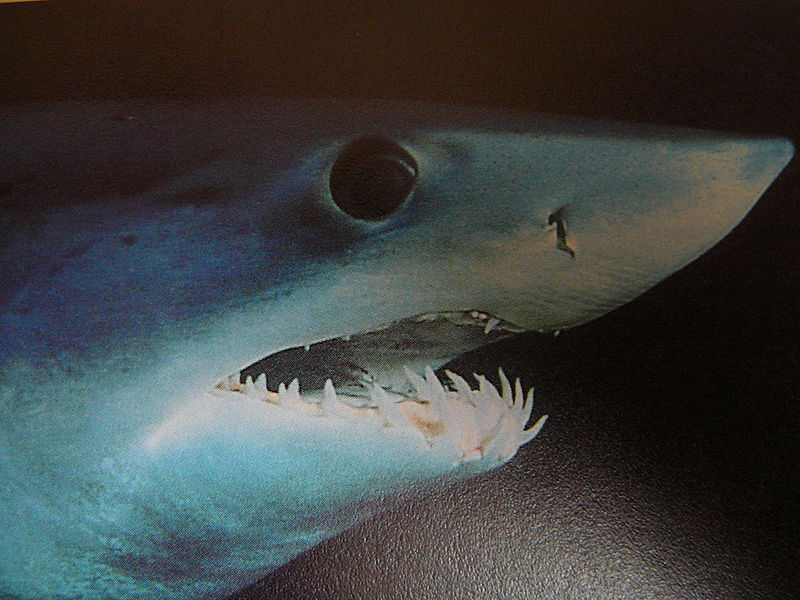
Seeing as the ocean is the largest environment on earth, and the one that we’re the least adapted for, it follows that we’re a bit naturally skittish of it and the things that live inside it, particularly its bigger predators. Not only are they possessed of pointy teeth and the natural inclination to put them to gruesome purposes, but they take the worrying fact of large carnivores being far more physically capable than we are and add in a new terror: that we are naturally helpless in their environments. A lion is scary. A tiger is scary. A bunch of wolves is scary. A shark is very scary, because not only is it large and capable of physically harming us, we’re also confronting it in the sea, where our ability to run away, hide, and fight is magnificently inept. Sure you can’t usually outrun, outfight, or evade any of my other examples, but at least you can try. Attempting most actions in the ocean as a human is like trying to get around some thick woods with no arms, a pair of broken legs, and diabetes. It’s possible, but you’ve got a pretty big set of handicaps. And if you tried to live there, you’d probably just die unless you brought along a hell of a lot of equipment.

So sharks are scary. They’re big predators, and they’re big predators that dwell in places that make us feel helpless and inept. Natural paranoia is easy to fall for here, even though sharks are a pretty varied lot and plenty of them pose as much threat to humans as, say, moose.

The face of fear.

The face of fear.

The maw of terror.

The maw of terror.

However, those sharks don’t interest people as much because, paradoxically, we like things that have the potential to kill us a whole bunch. So, in order to appease all our morbid interests, allow me to present the three sharks widely regarded as the most dangerous on the planet. Let’s start with the third.

The Bull Shark

It's in your rivers, eating your legs.

It's in your rivers, eating your legs.

The bull shark is, to put it bluntly, fairly plain in appearance. It’s pretty big (7-13ish feet or so) but not enormous, coloured unexceptionally, and a bit stout. It’s also very, very grumpy, highly territorial, likes shallow waters that people tend to splash about in, and looks generic enough that it’s often difficult to recognize. If you can rearrange the letters in that last sentence to spell out “disaster” then you’re lying but also quite perceptive. It’s responsible for a long list of bitings, gnawings, gnoshings, chompings, de-limbings, and outright murderations.

What makes the bull more than just a somewhat ordinary-looking but highly touchy genera-shark is its ability to tolerate freshwater environments. Shark blood is highly concentrated to prevent osmosis from sucking out their juices into the saltwater of the ocean, and if you put the standard shark in freshwater it’ll suffer the reverse effects – the much more diluted liquid flushes itself into the shark like there’s no tomorrow, with less than pleasing results. Bull sharks have developed the ability to alter their blood concentration, dropping it for long freshwater trips and raising it again when they head out to the ocean. They also get rid of a lot of their excess water on freshwater trips via urine. Lots of it.

By the way, if you’re wondering just how well this thing tolerates fresh water, Lake Nicaragua in Central America has a permanent population of them. Occasionally seagoing relatives stop by to hang out via rivers into the Caribbean. They’ve been found thousands of miles up the Amazon and the Mississippi. One made it into Lake Michigan at one point. They’re pretty dedicated travellers. For all you know, one could have made it into your city’s water reservoir and spent years tunneling its way through the pipes with its fangs. It could be waiting right underneath your bathtub’s drain for the sound of movement that will trigger its steely muscles to unleash a deadly fury that will smash through your bathroom floor like wet paper and shove dagger-like teeth into your soft, tasty innards.

The Tiger Shark (AKA “the Garbage Can of the Ocean”)

Portrait of a gourmet.

Portrait of a gourmet.

The second point on our list is the tiger shark. It’s capable of getting quite a bit bigger than the bull (10-20 feetish – making it probably the second largest predatory shark) and is further distinguished by its wedge-shaped noggin, striped sides (which are most prominent in youth and fade with maturity), notched teeth, bad attitude, and peculiar habit of eating things apparently just for the hell of it. When you find those long lists of odd things sharks have eaten (license plates, suits of armor, barrels), odds are the tiger’s responsible. Its more organic meals take the forms of fish, seals, sea turtles, sea birds, other sharks, squid, and honestly just about anything else that looks at it funny and appears edible. And as stated above, sometimes the last one’s optional.

Tigers are most tropical to subtropical animals, but they edge into cooler water sometimes. They’re often found in water relatively shallow for sharks of their impressive largeness, and this combined with their aggressive attitude and tendency to eat things on a whim firmly seats them in second place on this list. Hawaii, Florida, and Australia, or at least their swimming populations, can attest to this.

The Great White Shark (AKA White Pointer, White Death, White Shark)

Not a white supremacist, although fairly supreme in its own right.

Not a white supremacist, although fairly supreme in its own right.

The most dangerous and largest predatory shark on the planet at the moment (averaging 13-16 feet and going up to 20 feet and slightly over), and therefore the shark most likely to appear in movies with crappy special effects. The great white is only white against its belly, with an upper colouration that ranges from blue to black to brown, creating a countershading effect that makes the shark more difficult to see when viewed from above or below.

The adult white’s fangs are built for sawing through thick chunks of meat, with lots and lots of serrations like you’d get on a really good steak knife in a fancy restaurant. This is perfect for its prey, which is typically marine mammals. Seals, sea lions, dolphins, porpoises, and so on. Unfortunately, humans are about the same size as several of those prey items, and are also mammals. This can lead to cases of mistaken identity, which usually resolve themselves with an embarassed great white swimming away and an equally embarassed but somewhat distracted human messily bleeding out in midwater. Alternatively the shark may realize that you aren’t its typical menu item before it strikes, in which case it may ignore you or decide to check you out. Since it has no hands and its skin is thicker than a good leather jacket, if it wants a close-up examination it has to mouth you. Unfortunately, no matter how gentle it is, you’re liable to get stabbed during the mouthing process. The good news is that in the process the great white will have likely realized that your high muscle-and-bone to fat ratio makes you a highly un-nutritious meal and swum off. There’s only so much room in a shark’s gut, and an unfatty meal item as large as a human is a phenomenal waste of space that could go towards some delicious elephant seal.

The above gives a fairly nice idea of why great whites are dangerous to humans. However, that’s only half the picture. The other half is proximity. Great whites love to eat seals and sea lions. Therefore, they are found near seals and sea lions. Seals and sea lions are found in large numbers in California, South Africa, and Australia. Therefore, great whites are found in large numbers in these locations. California, South Africa, and Australia are home to loads of swimmers, surfers, spearfishers, snorklers, divers, and other people mucking about in the ocean and on the beach. Therefore, oh shit.

It’s important to remember, despite all of this, that sharks most definitely do not think of humans as food items. If they did, no one would ever go anywhere near the ocean, even with their populations hacked down to their current, abysmally low levels through fishing. Most human-shark encounters probably end with the human not even knowing the shark was anywhere near them. Most sharks aren’t dangerous to humans at all. Most shark attacks are easily treated and shark attacks themselves are rare as hell. Even with all of this taken into account, large, predatory sharks are always going to be scary based on the very issues I mentioned at the start of this ramble: they are very large predators that dwell in an environment in which not only are they supreme but we are abjectly helpless in a manner like nowhere else on earth.

Don’t fear the sharks. You don’t have to love them, cherish them, and try to give them huggles (that last one’s a bad idea all around), but you don’t have to fear them. And you definitely should not hate them. Ever. If you have to hate something, hate dolphins, because we all know what smug little buggers they are, with their cutesy faces and high levels of intelligence and apparent attitudes of friendly curiosity that make forming anthromorphic attachments as easy as playing pin-the-tail-on-the-elephant. At least hating dolphins is a challenge, with a lot of mental effort going into forming delusions that large. Hating sharks is like hating people who don’t quite agree with you: it’s easy to do and a sign that you are a major-league dip with the intelligence of a fruitcake. And if you don’t quite agree with that, I hate you.

As a parting note, there is only one species of shark that is to be actively loathed on its own merits, and it is found on the internet exclusively.

The Lolshark (AKA “Proof of Abuse of Graphics Programs”)

The horror.

The horror.

Thankfully far rarer than the lolcat. A shark that is given a caption is a sad thing whose very existence is inhumane and insulting to sharks as a whole. The lolshark pictured here is a perfectly innocuous basking shark, a cousin of the great white that feeds exclusively on plankton and that comes in second place in the “largest shark existing” awards, just behind the whale shark, an equally peaceful filter-feeder that also moonlights as the largest living fish. Now it is but a wretched shadow of its former self that exists only “for the lulz.” If you are unfortunate enough to come across one of these once-noble creatures, put it out of its misery immediately.

Now that that’s over, you know a bit more about sharks and I’ve run through at least half of everything that I know. And knowing is half the battle. Which, in my case, I think I lost years ago.
All original material copyright Jamie Proctor, 2009.
Picture Credits (all items were lazily located on Wikipedia):
Moose: Picture taken by bcameron54 on June 01 2008 off the shoulder of Highway 60 in Algonquin Park, Ontario, Canada.
Horn Shark: Picture taken by Magnus Kjaergaard in La Jolla, California.
Bull Shark: Public domain image from Wikipedia.
Tiger Shark: Adult female tiger shark, “Scarface”, approximately 16 feet in length, exact age unknown. Taken May 2007 at Shark Reef Marine Preserve, Beqa Lagoon, Fiji, by Terry Goss (Nikon D70S w/Nikkor 12-24mm in Ikelite housing, natural light at 65fsw). More at http://terrygoss.ifp3.com.
Great White Shark: Original image summary: Photo by Terry Goss, copyright 2006. Taken at Isla Guadalupe, Mexico, August 2006. Shot with Nikon D70s in Ikelite housing, in natural light. Animal estimated at 11-12 feet (3.3 to 3.6 m) in length, age unknown. More photos can be found at http://www.flickr.com/photos/pterantula/sets/. Removal of distracting elements from Image:Whiteshark-TGoss5b.jpg (taken by Terry Goss), edited in Helicon Filter by Althepal.
Lolshark: Nightmarishly twisted from a public domain image of a basking shark found on Wikipedia.

First.

February 16th, 2009

This post has been sanctioned “first” in accordance with the harmonious and ancient policies of the internet. May it live long and prosper, be viewed by more than a single digit’s worth of people, and be unblemished by server trouble, trolling, flaming, or leet haxing.

On the topic of “firsts” beyond their internet applicability as “that stupid message trolls post on comments sections and forum threads rather than actually thinking,” an interesting statistic that I may have hallucinated once stated that most blogs rarely get past that first sixpack or so of giddy posts, and a fairly major amount stall out on their very first. I don’t know about you, but I personally just can’t wait to become a statistic.

Anyways, maybe you’ll find some stuff here. Maybe you’ll even like it. Either way, it’s now time to wait in something quite a bit less than suspense as I muddle around and figure out how to run what is probably the simplest website design known to man.